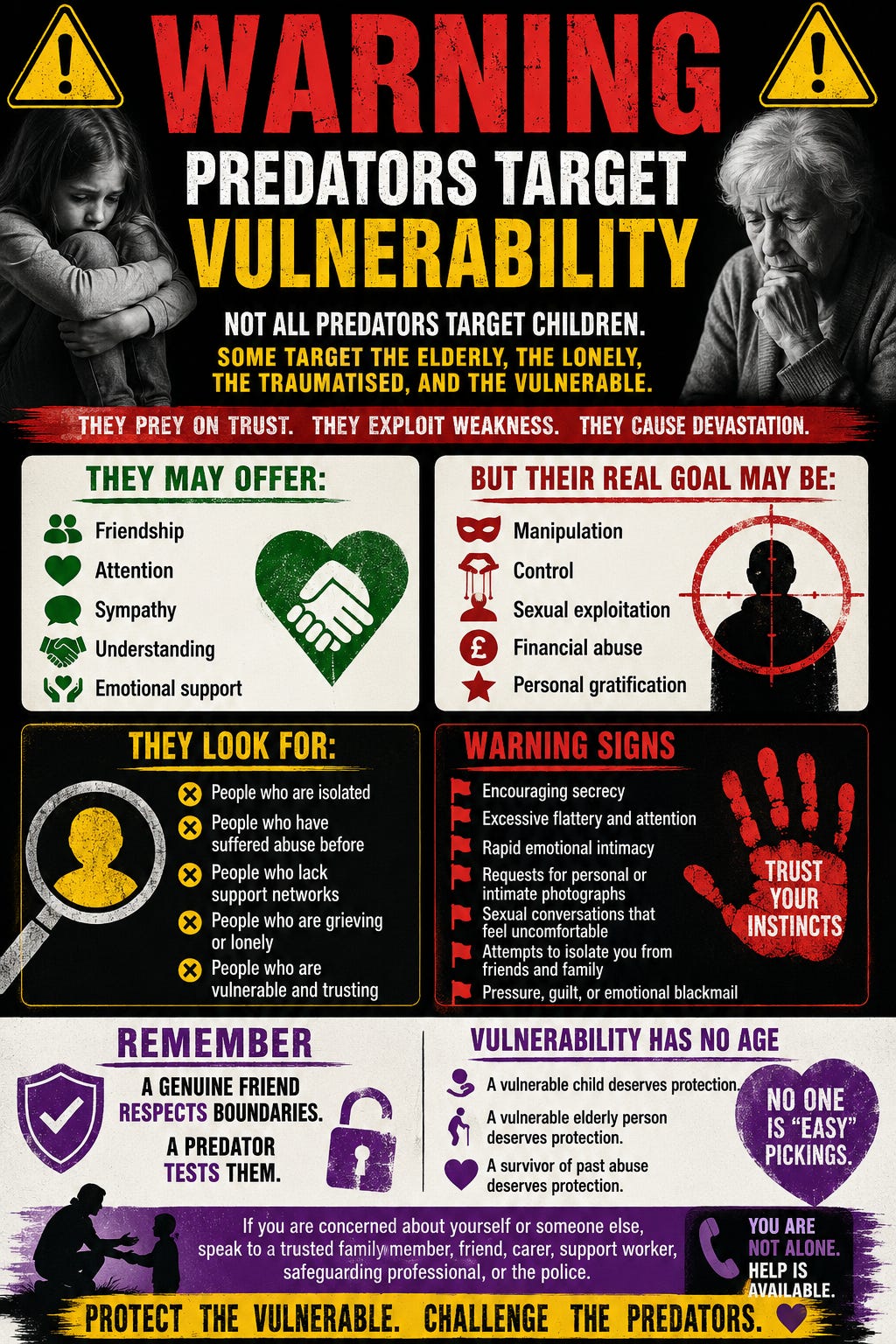
When Vulnerability Never Truly Leaves.
The Ethics of Sexual Harassment Against Elderly Survivors of Child Abuse.

Society rightly condemns adults who groom children for sexual purposes. The reasons are obvious. Children are vulnerable, impressionable, and susceptible to manipulation by those who seek to exploit them. We understand instinctively that targeting a child’s weaknesses for sexual gratification is predatory behaviour.
Yet there is another group of vulnerable people who often receive far less consideration: elderly survivors of childhood abuse.

Many people assume that the passage of time heals all wounds. A child abused decades ago becomes an adult, then eventually an elderly person. To outside observers, the trauma may appear to belong to the distant past. The victim has grown older, gained life experience, and survived.
But trauma does not operate according to a calendar.
For many survivors, childhood abuse leaves lifelong scars. Trust may remain fragile. Boundaries may be difficult to enforce. Feelings of shame, fear, and vulnerability can persist long into old age. While some survivors become remarkably resilient, others continue to carry emotional wounds that can be reopened by insensitive or malicious behaviour.
This raises an uncomfortable question.
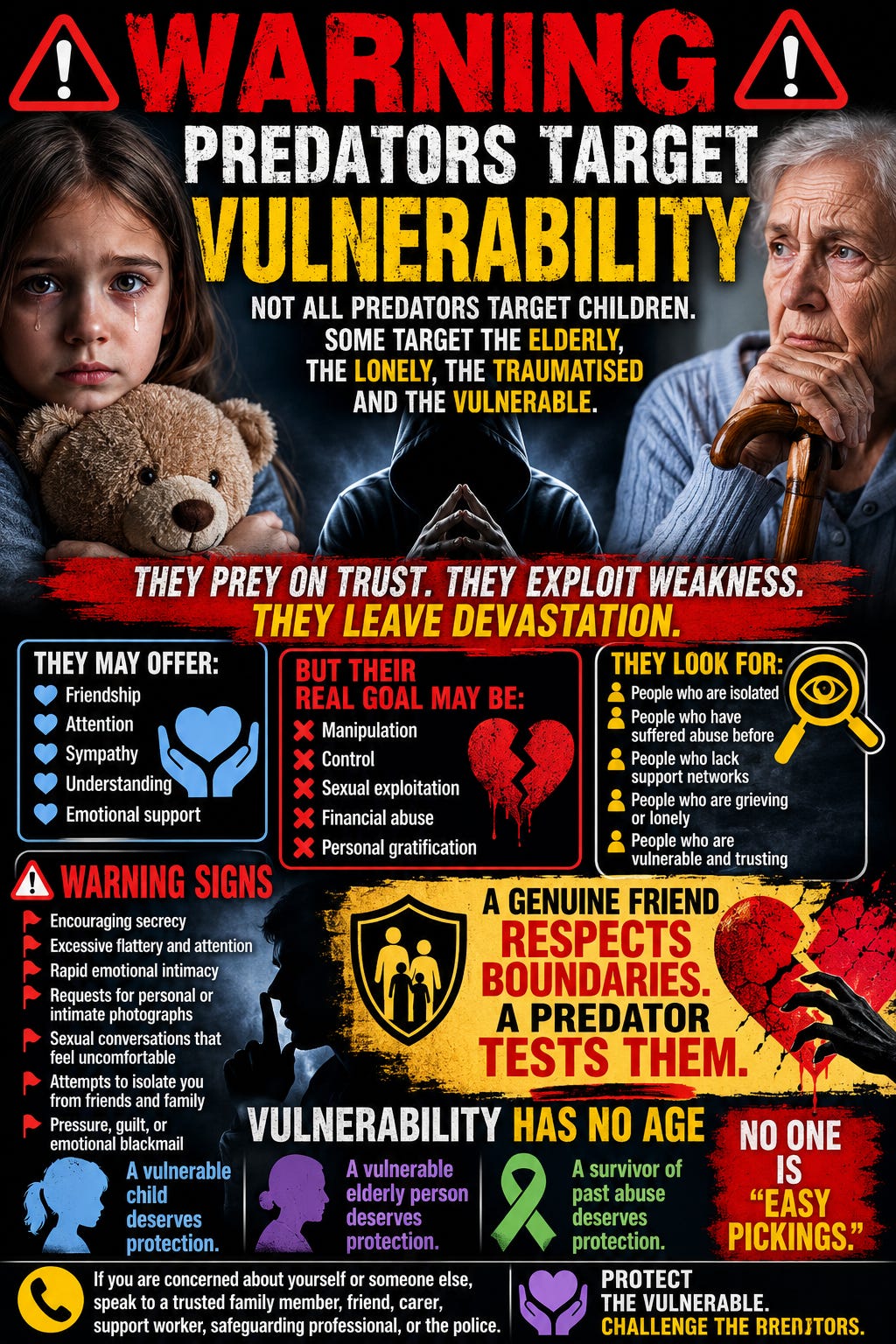
What should we think of individuals who deliberately target elderly survivors of child abuse with sexual harassment?
Consider the scenario. Someone sends sexually explicit messages to a known survivor. They share videos intended to sexualise or provoke. They request nude photographs. They use sexual themes as a means of humiliation, intimidation, or control. They know the recipient’s history. They know the person is vulnerable. Yet they proceed anyway.
Legally, this is not the same as child grooming. An elderly adult is not a child. They possess legal autonomy and the right to make their own decisions. The comparison should not be stretched beyond recognition.
However, there are uncomfortable similarities in the methods employed by those who prey upon vulnerable people, regardless of age.
Predators often look for weakness. They identify emotional wounds. They test boundaries. They normalise inappropriate interactions. They seek compliance. They exploit loneliness, fear, confusion, or the desire to be accepted.
The tactics may differ from case to case, but the underlying principle remains remarkably consistent: vulnerability becomes an opportunity.
What makes such conduct particularly troubling is that it can amount to a form of retraumatisation. Survivors of childhood abuse have already experienced violations of trust and personal boundaries. When another individual knowingly subjects them to sexual pressure, harassment, or humiliation later in life, those experiences may echo the original abuse in deeply damaging ways.
The victim is not being treated as a person deserving of dignity. They are being treated as an object whose vulnerabilities can be exploited for entertainment, gratification, or power.
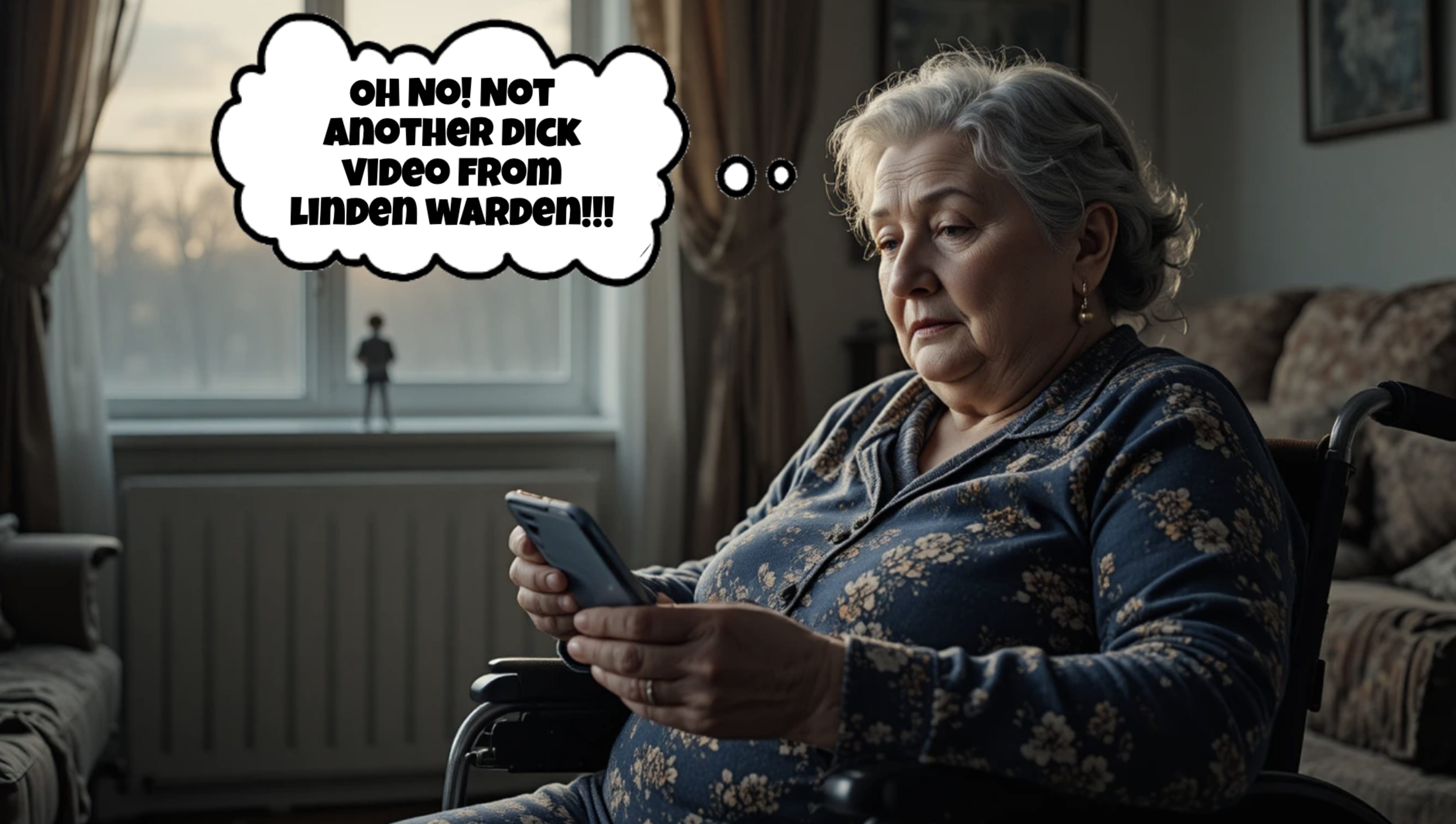
A civilised society should reject that principle regardless of the age of the victim.
The central issue is not whether an elderly survivor should be regarded as a child. They should not. The issue is whether people should knowingly exploit trauma and vulnerability for their own purposes.
The answer ought to be obvious.
Adults deserve respect. Survivors deserve respect. Elderly people deserve respect. When all three characteristics exist in the same individual, the obligation to act with care becomes stronger, not weaker.
Trauma-informed approaches to safeguarding recognise this reality. They acknowledge that vulnerability does not always disappear with age. Some wounds heal. Others remain sensitive throughout a person’s life. Understanding that fact is not patronising. It is simply recognising the complexity of human experience.
Perhaps the real lesson is this: vulnerability is not defined solely by age. It can arise from trauma, grief, disability, illness, isolation, or countless other circumstances. The moral test of any society is not how it treats the strong and resilient. It is how it treats those who remain vulnerable.
When someone knowingly exploits the vulnerabilities of an elderly survivor of childhood abuse, they are not engaging in harmless banter. They are taking advantage of a person whose dignity deserves protection.
And that is something worth taking seriously.
Vulnerability Has No Age: Why the Sexual Exploitation of the Elderly Is as Serious as the Sexual Exploitation of Children.
When people hear the words “sexual grooming” or “sexual exploitation,” they often think immediately of children. Society rightly condemns those who target children for sexual purposes because children are vulnerable, trusting, and often unable to recognise manipulation until significant harm has already been done.
What is discussed far less frequently is the sexual exploitation and grooming of elderly people. Yet many of the same mechanisms used against children can also be used against vulnerable older adults. While the circumstances differ, the underlying abuse of trust, power, and vulnerability is strikingly similar.
At its heart, grooming is not about age. It is about exploiting vulnerability.
A predator looks for weakness. They look for loneliness, dependency, emotional needs, confusion, isolation, trauma, or a desire for acceptance. The objective is often the same: to gain control, obtain sexual gratification, extract personal information, manipulate behaviour, or establish an unhealthy relationship in which the victim’s interests are secondary to the abuser’s desires.
Children are vulnerable because they lack life experience and are still developing emotionally and intellectually.
Some elderly people become vulnerable for different reasons. They may suffer from loneliness after losing a spouse. They may experience declining health, reduced social contact, cognitive difficulties, or increasing dependence on others. They may be desperate for companionship and human connection. These factors can make them attractive targets for manipulative individuals.
The cruelty becomes even more disturbing when perpetrators deliberately seek out elderly people who have already suffered abuse earlier in life.
Many survivors of childhood sexual abuse carry emotional wounds for decades. Feelings of shame, self-doubt, fear of rejection, and difficulties establishing healthy boundaries can persist well into old age. Predators understand this. They often seek people who have been traumatised because trauma can make someone easier to manipulate.
This is one of the ugliest aspects of exploitation.
Imagine a child who is abused and groomed, survives that experience, spends decades carrying the psychological consequences, only to find themselves targeted again later in life by another manipulator who recognises those old wounds and sees them as an opportunity.
The predator is not merely exploiting vulnerability. They are exploiting damage that was inflicted by previous predators.
Such behaviour demonstrates a profound lack of empathy. It treats a human being not as a person worthy of dignity and protection, but as an easy target. The perpetrator sees prior victimisation not as a reason for compassion, but as a reason to attack.
The tactics often follow familiar patterns.
The abuser may shower the victim with attention and affection. They may create a sense of exclusivity or special connection. They may gradually introduce sexual topics, test boundaries, pressure the victim into sharing intimate information, request explicit images, or attempt to normalise inappropriate behaviour. They may convince the victim that nobody else understands them or that the relationship must remain secret.
These are classic manipulation techniques, regardless of whether the victim is sixteen or eighty-six.

The emotional damage can be devastating.
Victims often experience humiliation, shame, confusion, anxiety, depression, and a profound loss of trust. Family relationships can be affected. Existing trauma may be reopened. A person who has spent years trying to heal can find themselves reliving old wounds because someone chose to exploit their vulnerabilities for personal gratification.
The idea that exploitation somehow becomes less serious because the victim is elderly is deeply misguided.
Human dignity does not expire with age.
A vulnerable sixty-year-old deserves exactly the same protection from predators as a vulnerable six-year-old. Society should be equally disgusted by those who deliberately seek out vulnerable elderly people for sexual exploitation, particularly when they target individuals with known histories of abuse and trauma.
The measure of a society is not merely how it protects the young. It is also how it protects those who have become vulnerable through age, illness, isolation, or past suffering.
Predators who target children are rightly condemned because they prey upon vulnerability. The same principle applies when predators target the elderly.
In both cases, the abuse is rooted in the same ugly reality: someone choosing to exploit weakness instead of protecting it, choosing manipulation instead of compassion, and viewing another human being not as a person, but as an opportunity.
That is why sexual exploitation and grooming of vulnerable elderly people deserves the same seriousness, attention, and condemnation as any other form of predatory abuse.